Anxiety is becoming more common in children; the CDC estimates that 25% of teens are treated for an anxiety disorder. Children and teens who do not experience clinical levels of anxiety also have worries and fears that, if unaddressed, could lead to the development of mood disorders as an adult.
So, what do we do to help our worried or anxious child? How can we help them respond skillfully to stress and develop resilience? This series of blog posts on Helping Children Manage Their Worries and Fears addresses these questions.
Part 3 – RESILIENCE
Anxiety feeds on rigid thinking styles. A flexible mindset, on the other hand, allows someone to handle life’s ups and downs without undue stress. Resilience is the term used to describe this ability to cope with disappointment and confidently move forward.
Most adults have developed the mental flexibility to accommodate minor adjustments in plans and schedules. Things like traffic jams and unexpected bills can be mildly upsetting, maybe even very stressful, but not disastrous. Adults know that life has ups and downs, and we have accumulated enough evidence from past experience to believe that, for the most part, we are equipped to handle what comes our way. Children are not just “little adults,” however, and lack this reflexive ability to adapt to unexpected change.
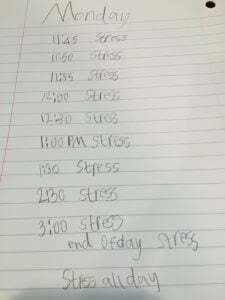
By our mid-twenties we have technically developed cognitive structures that support mental flexibility but for some reason many adults continue to employ rigid patterns in their thoughts and behaviors. The impact of this, as Brene Brown, Ph.D., points out, is that we are the most medicated, addicted, overweight, stressed out generation ever. And we are modeling this for our children, who are also stressed out. It was a really big wake up call for me the day I found my fourth grader’s daily schedule, pictured above! Clearly we needed to focus on developing mental flexibility and resilience at our house!
The best way to teach a child a new skill is to model it. How many of us have winced when overhearing our child parrot something they’ve heard us say? If you have, you’ll agree that example is powerful!
In addition to modeling resilience for our children, we can teach them to problem solve in ways that foster the development of this mindset. According to Sam Goldstein, Ph.D., there are two important steps, beyond practicing what we preach, in helping children cope confidently with change. These include:
1) Provide choices at an early age to help children learn to draw independent conclusions.
2) Follow a problem-solving sequence that includes elements of labeling the problem correctly, identifying more than one way to solve the problem, and developing a check-in system so that you and your child can continue to communicate about progress.
LINKS: Helping Children Manage Their Worries and Fears
PART 1 – When Parents Fight
PART 2 – Back To School